Battle For Glory 3 Fast Play Edition
TITLE: Battle for Glory 3
AUTHOR: Get the Lead Out
PUBLISHER: Get the Lead Out
PUBLICATION DATE: 2026
WEB SITE/SUPPORT FORUM: None
PRICE (with date): $5.00 (in 2026)
REVIEWED BY: Mark “Extra Crispy” Severin
PERIOD COVERED: The American Civil War
THE BOOK:
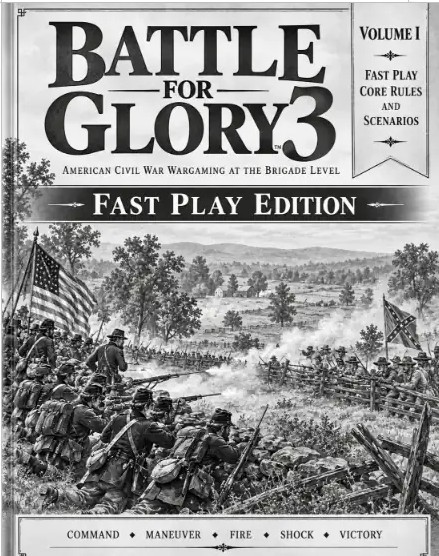
Battle for Glory (BfG) is a 94 page black & white PDF. Of those 60 are actual rules with remainder comprised of optional rules, examples, and an introductory scenario. The cover indicates this is "Volume 1" so I assume future volumes will include more scenarios, OOBs etc.
SCOPE: BfG is designed to recreate battles of the American Civil War with units representing brigades.
ARMY SIZE: Each unit is comprised of 3 or occasionally 4 stands. Bases are not huge but you will need a reasonably large collection to use these rules.
BASE UNIT:
Units represent brigades of infantry and cavalry, and batteries of artillery.
GAME SCALES:
- Ground Scale: 1”= 100 yards
- Time scale 1 turn = 20 minutes
- Figure/Base Ratio: None given
- Figure Size: Any
- Table Size: Any
- Game Length: Most games should be playable in one evening
BASING SIZES:
There are no specified base requirements. Depending on what scale figures you use, the authors recommend bases 20-30mm wide (for 3mm figures) to 40-60mm wide (for 15mm figures.
TURN SEQUENCE:
- The Orders Phase: Roll to change a division's order, if desired.
- Initiative: Roll to determine which player has the initiative. Re-roll ties.
- First Side Movement: The player with initiative moves all his troops. Defensive fire may * happen in this phase, if an enemy unit is closed with.
- Second Side Movement
- Fire Phase: Players resolve all firing, including return fire and Firefights (see below).
- Melee Phase: Players resolve all melees.
- Recovery & Command Phase: Make checks to recover morale, recover from low ammo and assess Divisional cohesion.
GAME MECHANICS:
Dice:
All dice rolls consist of a single D20. In general, you want to roll low. Reading the rules it is important to remember which modifiers raise or lower the target number and which modifiers are applied to the die roll.
The Roster System:
All units have from 1 to 6 Combat Effectiveness Points (CEPs). As units take losses, these are marked off on a roster. In addition, units may lose cohesion as component brigades are disordered, broken or routed. There is no stand removal. When a unit is reduced to 0 CEPs the entire unit is removed from play.
In addition, each division has Cohesion. As component brigades are disordered or routed divisions suffer. Initially it just makes changing orders harder, but eventually the entire division will need to withdraw from battle.
Command and Control:
BfG uses a basic “command radius” system. A division commander’s is 12". Units must remain within his command radius or suffer various penalties. Corps commanders add their ratings to their subordinates. Commanders are also rated for quality which confers benefits in firing and morale.
The game also has a simple order system. Orders limit your division's actions. Orders may only be changed by a die roll.
Movement:
Every unit has a number of Movement Points (MPs) based on its unit type and formation. Each inch of terrain costs a number of MPs to cross. The terrain rules are very detailed, and the terrain chart includes 18 types of terrain (many of which may not be needed, such as fords or built up areas). There are two such charts but they are not labeled. I assume one is for inf/cav and the other for artillery?
The rules cover line of sight in detail, as well as cover, etc. In general you can see into or out of terrain but never through it. Some terrain restricts line of sight within it (heavy woods restrict range to 1" inside them).
There are three formations - line, march column and assault column. Rotating or changing formation also costs MPs.
Fire Combat:
Small arms and artillery are both resolved the same way. Roll a D20 and add the unit's current CEPs. Then modify for terrain, cover, firer's quality, enfilade etc. On a result of 10 or more, you have hurt the enemy. Fire results are both morale (disordered, broken) and CEP losses. Morale is not rolled - losses from fire are automatic.
Firefights occur when both sides can fire at each other. In this case fire is simultaneous. Fire is also deadly with a +3 die roll modifier. Also, nearby units may count as supports for a positive die roll modifier.
Melee:
Melee is resolved with an opposed die roll. As with fire combat it is a single D20. You add your unit's CEPs and modify for unit quality, flanks, terrain etc. The difference in the rolls determines the winner. Losers take hits and suffer morale loss, as well as retreating. Winners may advance after combat and never take losses. There is only ever one round of combat.
Morale:
Morale is only rolled during the Recovery segment. There are only a handful of modifiers and a success improves your morale one level.
ARMY LISTS/SCENARIOS:
The rule book includes one fictional scenario - missing the map- as well as extensive leader ratings.
REVIEWER’S COMMENTS:
Overall this seems like an pretty standard set of rules. It really offers nothing new. It reads perfectly playable, just needs a bit of editing. At $5 though, it may be just right for you!
PLAYER’S COMMENTS:
Not played.